Introduction
Humanoid robots are hard to build because the whole machine has to work as one system. Legs, hands, sensors, batteries, compute, simulation tools, data pipelines, and safety controls all affect each other.
A reference design gives teams a shared starting point. It does not solve humanoid robotics by itself, but it can reduce the time spent rebuilding the same basic stack.
Quick Answer
A humanoid robot reference design is a documented baseline for building and testing a humanoid platform.
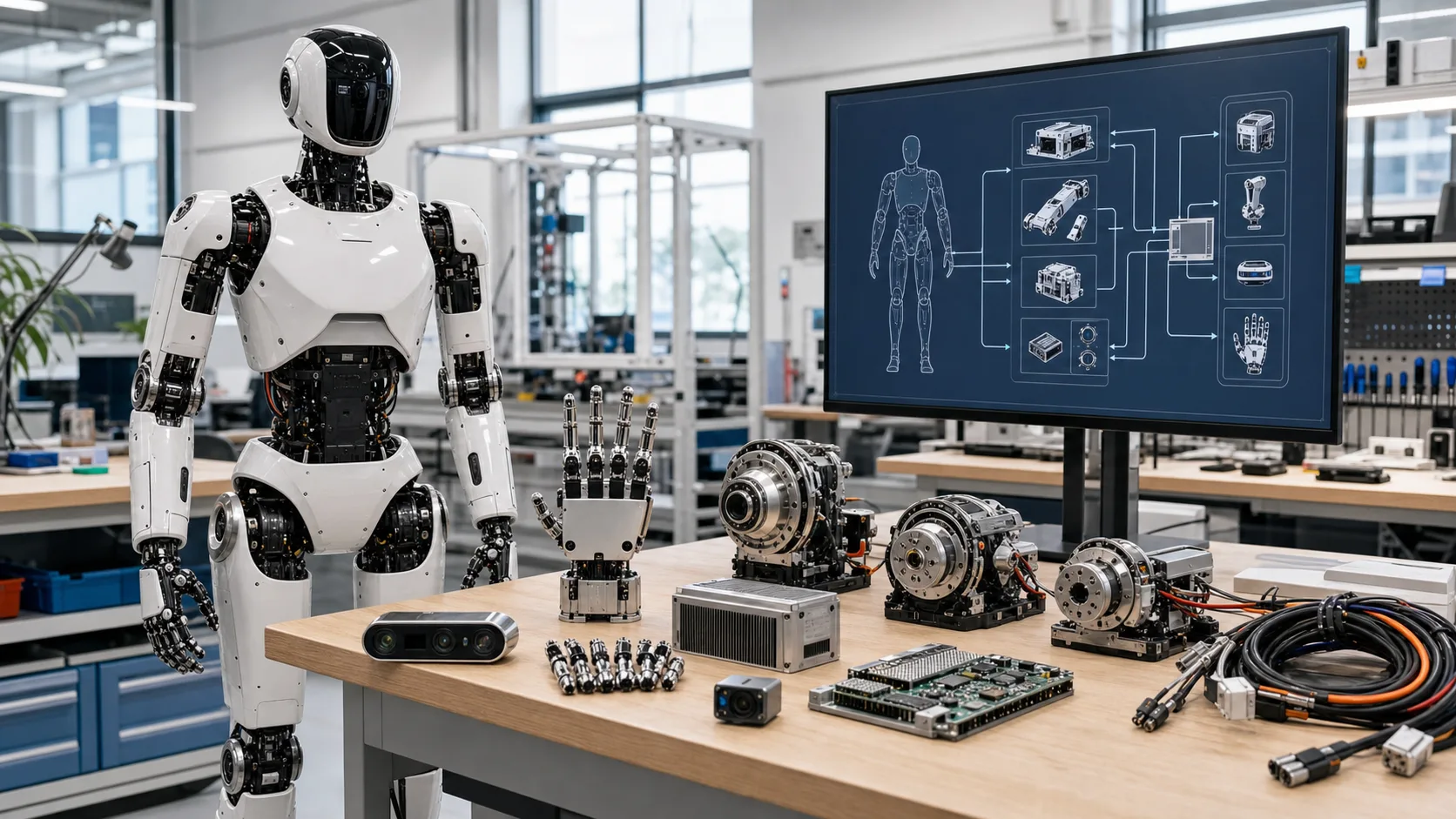
It usually combines hardware choices, software interfaces, simulation workflows, data collection methods, and deployment guidance. The goal is to make results easier to reproduce and products easier to compare.
Reference designs matter because humanoid robots are moving from impressive demos toward repeatable engineering.
Why This Matters
Humanoids need more than a clever model or a strong motor.
They need balance control, whole-body motion, hand manipulation, perception, task planning, real-time compute, thermal design, batteries, emergency stops, and field service. A weak part in any one layer can make the full robot unreliable.
That is why the industry is starting to care about shared baselines. In June 2026, NVIDIA announced the Isaac GR00T Reference Humanoid Robot for academic research. NVIDIA described it as an open humanoid reference design built around a Unitree humanoid chassis, dexterous hands, Jetson Thor onboard compute, and the Isaac GR00T software platform.
The announcement is important because it shows a broader shift. Humanoid development is no longer only about building a body. It is also about building a repeatable development path.
What A Reference Design Includes
A good reference design is not just a bill of materials.
It should answer practical engineering questions:
- What robot body, hands, sensors, batteries, and compute are used?
- What middleware and interfaces connect the subsystems?
- How are teleoperation, data capture, training, simulation, and deployment handled?
- How are safety stops, logs, calibration, and evaluation managed?
- Which parts are open, which parts are vendor-specific, and which parts can be swapped?
For humanoids, the last question matters. A platform that cannot be modified may be useful for demos, but less useful for research and product development. Teams need to change hands, sensors, policies, tasks, and test environments without rebuilding the full stack.
Why Humanoids Are Especially Fragmented
Mobile robots and robot arms already have mature categories. A warehouse AMR can often be compared by payload, navigation, fleet software, battery life, and safety certifications. An industrial arm can be compared by reach, payload, repeatability, and controller ecosystem.
Humanoids are different. The category is still forming.
One humanoid may be optimized for walking research. Another may focus on warehouse work. Another may emphasize hand dexterity, voice interaction, or household manipulation. Even when two robots look similar, their joints, hands, cameras, control loops, and training data can be very different.
This makes comparison difficult. It also makes software reuse difficult. A manipulation policy trained on one robot may not transfer cleanly to another robot if the hands, cameras, joint limits, or control rates are different.
Reference designs help by creating known baselines. Researchers can test new algorithms on a shared platform. Developers can see which component changed when performance improves. Suppliers can design parts around clearer integration targets.
Reference Designs Help Data Collection
Modern humanoids depend heavily on data.
A robot may need human demonstrations, teleoperation recordings, simulated trajectories, synthetic data, and real-world failure cases. But data is only useful if teams understand the hardware and conditions that produced it.
If every lab uses a different camera layout, hand design, joint controller, and logging format, the data becomes harder to combine. A reference design can define standard sensor positions, calibration procedures, recording formats, and task setups.
That does not make all data universal. It does make it easier to tell whether a model improved because of better learning, better hardware, cleaner data, or a simpler test.
Reference Designs Improve Simulation
Simulation is central to humanoid development because real-world testing is slow, expensive, and risky.
But simulation only helps when it matches the real robot closely enough. The robot's mass, joint limits, actuator behavior, foot contact, camera placement, and hand geometry all matter.
A reference design gives simulation teams a clear target. Instead of guessing the robot's physical layout, they can work from a known model. That helps researchers test locomotion, manipulation, and perception before moving to hardware.
Simulation will still miss details from the real world. Floors are different. Objects deform. Sensors have noise. Humans behave unpredictably. But a shared reference platform can make the gap easier to measure.
Reference Designs Make Safety Easier To Discuss
Humanoid safety is difficult because the robot is large, mobile, and able to interact with people and objects.
A reference design can make safety discussions more concrete. It can document emergency stop behavior, payload limits, torque limits, operating zones, recovery modes, logging, and test procedures.
This is not the same as certification. A reference design does not automatically make a humanoid safe for factories, warehouses, hospitals, or homes.
But it gives developers a common language. Instead of only saying a robot is "safe," teams can discuss specific behaviors: how it stops, how fast it moves near people, how it detects faults, and how it recovers after losing balance.
Why Open Interfaces Matter
Reference designs are most useful when they are modular.
Robotics teams already rely on shared software ecosystems such as ROS 2, which provides open-source tools and libraries for building and running robot applications. Fleet-level projects such as Open-RMF and interoperability efforts in mobile robots show the same pattern: the industry benefits when robots can communicate through clearer interfaces.
Humanoids need a similar mindset, but the problem is harder. The robot is not only driving from point to point. It is balancing, reaching, grasping, seeing, listening, and deciding what to do next.
Open interfaces can help prevent humanoid robots from becoming isolated machines with one-off software. They can also make it easier for component companies, AI labs, and application developers to work on the same platform.
What Reference Designs Will Not Fix
Reference designs are not magic.
They do not guarantee low cost. They do not prove commercial demand. They do not solve battery life, hand durability, model reliability, or real-world safety.
They also create strategic tradeoffs. If many teams use the same baseline, the ecosystem may move faster, but it may also concentrate around a few platform vendors. Smaller companies may benefit from easier integration while also becoming dependent on someone else's roadmap.
The best reference designs will therefore leave room for competition. They should define enough of the stack to make development repeatable, but not so much that every robot becomes the same machine.
What To Watch
The next step is not just more humanoid demos. It is better evidence.
Watch for reference designs that publish useful documentation, simulation assets, software workflows, evaluation tasks, and hardware availability. Watch for whether researchers can reproduce results across labs. Watch for whether component suppliers begin building around common humanoid interfaces.
Also watch the gap between academic access and commercial deployment. A reference robot for research can speed learning, but production humanoids still need reliability, serviceability, supply chains, safety cases, and clear jobs to do.
Humanoid robots need reference designs because the field needs fewer isolated prototypes and more shared engineering baselines. That is how a complex robot category starts to become a repeatable platform.
FAQ
What is a humanoid robot reference design?
A humanoid robot reference design is a documented baseline for a humanoid system. It can include the robot body, hands, sensors, compute, software stack, simulation assets, and testing workflow.
Is a reference design the same as a finished product?
No. A reference design is a starting point for development and evaluation. A finished product still needs manufacturing, support, safety validation, customer workflows, and field reliability.
Why do humanoid robots need reference designs more than robot arms?
Humanoids combine locomotion, manipulation, perception, balance, power, and AI planning in one machine. That makes integration harder and makes shared baselines more valuable.
Do reference designs make humanoid robots safer?
They can help teams discuss and test safety more clearly, but they do not automatically make a robot safe. Safety still depends on design, validation, operating environment, and deployment rules.