What Is a Robot? A Beginner’s Guide to Robotics
Robots are no longer just something from science fiction. You can find them in car factories, hospitals, warehouses, homes and even on Mars.
But what exactly is a robot?
A simple way to think about it is this:
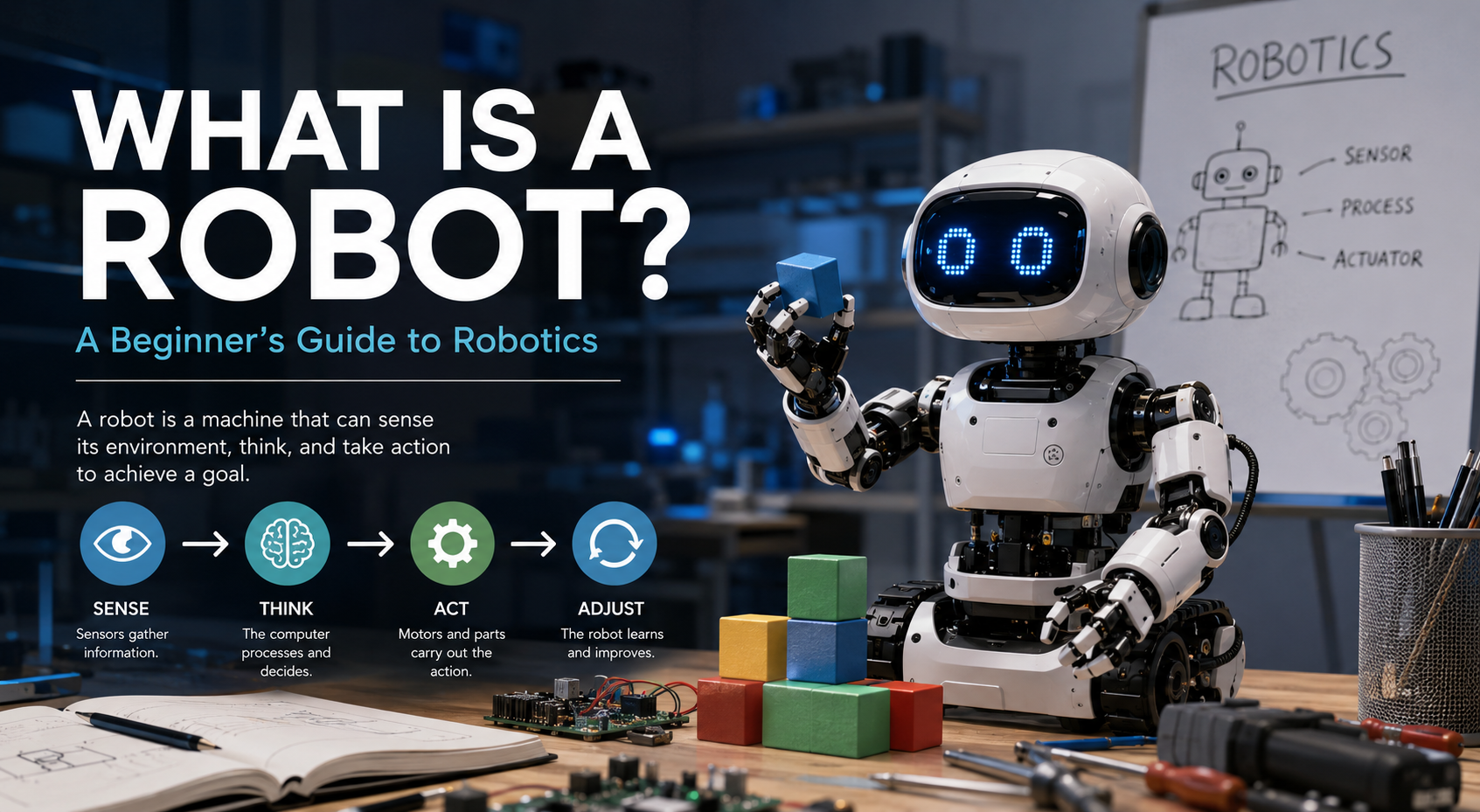
A robot is a machine that can sense what is happening, make a decision and take action in the real world.
That may sound complicated, but it is easier to understand if we compare a robot to a person.
A person uses eyes and ears to understand the world. A robot uses sensors. A person uses the brain to think and decide. A robot uses a controller or computer. A person uses muscles to move. A robot uses motors, wheels, arms or other moving parts.
So, in a very simple way, a robot is like a machine with “senses,” a “brain” and “muscles.”
What Makes a Machine a Robot?
Not every machine is a robot.
A toaster is a machine. A washing machine is a machine. An elevator is also a machine. But we usually do not call them robots because they mostly follow fixed instructions.
A robot is different because it can react to the world around it.
For example, a robot vacuum does not just move in one straight line forever. It can sense walls, avoid stairs and change direction when it meets an obstacle. That ability to sense, decide and act is what makes it feel more like a robot.
In simple terms, most robots follow this loop:
- Sense what is happening
- Think about what to do
- Act in the real world
- Check the result
- Adjust and repeat
This loop is called a feedback loop. It is one of the most important ideas in robotics.
A good comparison is riding a bicycle. You do not just move your body once and stop thinking. You keep checking your balance, adjusting the handlebar and correcting your movement. A robot does something similar, but with sensors, code and motors.
What Is Robotics?
Robotics is the field that studies how to design, build and use robots.
It is not just one subject. Robotics combines many areas, including:
- Mechanical engineering
- Electrical engineering
- Computer science
- Artificial intelligence
- Control systems
- Sensors and hardware design
This is why robotics can feel difficult at first. It touches many different fields. But for beginners, you do not need to understand everything at once.
You can start with one simple idea:
Robotics is about building machines that can interact with the physical world.
That is the key difference between normal software and robotics. A website or app lives on a screen. A robot has to deal with the real world, where things are messy, changing and sometimes unpredictable.
A Short History of Robots
The idea of robots is much older than modern computers.
Long before factories had robotic arms, people were already imagining mechanical helpers. Ancient stories described artificial servants, moving statues and mechanical animals. Some early inventors also built automata, which were mechanical devices that could move in clever ways.
These early machines were not robots in the modern sense, but they showed the same human dream: creating something that could move and act on its own.
The word robot came much later. It comes from the Czech word robota, which means forced labor. The word became popular after the 1920 play R.U.R. by Karel Čapek. In that story, robots were artificial workers created to serve humans.
Modern industrial robotics began in the 20th century. One of the most important early robots was Unimate, a robotic arm used in a General Motors factory in 1961. It handled hot metal parts, a job that was dangerous and repetitive for human workers.
From there, robots became common in manufacturing. Over time, better sensors, computers and artificial intelligence helped robots move beyond factories and into homes, hospitals, farms and public spaces.
The Main Parts of a Robot
Most robots have several basic parts. You can think of them like parts of a living body.
1. Sensors: The Robot’s Senses
Sensors help a robot understand the world.
A robot may use:
- Cameras to see
- Microphones to hear
- Touch sensors to feel pressure
- Distance sensors to avoid obstacles
- Gyroscopes to measure balance
- GPS to know location
Sensors are like the robot’s eyes, ears and skin.
Without sensors, a robot would be almost blind. It might still move, but it would not know what is happening around it.
2. Controller: The Robot’s Brain
The controller is the part that processes information and makes decisions.
It can be a small microcontroller, a computer or a more powerful AI system. The controller receives data from sensors, runs software and sends commands to the robot’s moving parts.
For example, if a robot vacuum sees a wall, the controller decides whether to turn left, turn right or slow down.
3. Actuators: The Robot’s Muscles
Actuators are the parts that make the robot move.
They can include:
- Motors
- Servos
- Hydraulic systems
- Pneumatic systems
- Robotic joints
- Wheels or legs
If sensors are the senses and the controller is the brain, then actuators are the muscles.
4. Power System: The Robot’s Energy
Robots need power to work.
Some use batteries. Some are plugged into electricity. Large industrial robots may use powerful electrical or hydraulic systems.
Without energy, even the smartest robot is just a pile of metal and circuits.
5. Software: The Robot’s Instructions
Software tells the robot what to do.
It can be simple, like “move forward until you see an obstacle.” It can also be complex, like recognizing objects, planning a route or understanding spoken commands.
Software is what connects sensing, thinking and action together.
Common Types of Robots
Robots come in many shapes and sizes. Some look like arms. Some look like cars. Some look like people. Some do not look like anything we would normally imagine as a robot.
Here are the most common types.
Industrial Robots
Industrial robots are widely used in factories.
They can weld, paint, assemble, cut, package and move products. Many industrial robots look like large mechanical arms. They are fast, strong and very precise.
They are especially useful for tasks that are:
- Repetitive
- Dangerous
- Heavy
- High precision
- Time-consuming
For example, in a car factory, a robotic arm can weld the same part thousands of times with consistent accuracy.
Service Robots
Service robots are robots that help people outside traditional factory production.
Examples include:
- Cleaning robots
- Delivery robots
- Medical robots
- Hotel service robots
- Restaurant robots
- Security robots
A service robot does not always need to look human. A small delivery robot on wheels is still a robot if it can sense, decide and move through the world.
Collaborative Robots
Collaborative robots are often called cobots.
They are designed to work safely near humans. Traditional industrial robots often need cages or safety barriers because they are powerful and fast. Cobots are usually smaller, slower and equipped with sensors that help prevent accidents.
Cobots are useful in small factories because they can help workers instead of replacing an entire production line.
Mobile Robots
Mobile robots can move from one place to another.
Examples include:
- Warehouse robots
- Robot vacuums
- Delivery robots
- Autonomous vehicles
- Mars rovers
A mobile robot needs to understand where it is, where it wants to go and what obstacles are in the way.
This is harder than it sounds. A room may be full of chairs, people, pets and changing objects. The robot has to keep updating its plan.
Humanoid Robots
Humanoid robots are robots shaped like humans.
They may have a head, arms, legs and a body. The reason for this design is simple: many places in the world are built for humans. Doors, stairs, tools and furniture are all designed around the human body.
If a robot has a human-like shape, it may be easier for it to work in human environments.
However, humanoid robots are very difficult to build. Walking, balancing, grabbing objects and understanding human behavior are all hard problems.
Social Robots
Social robots are designed to interact with people.
They may talk, show facial expressions, answer questions or provide companionship. Some are used in education, elderly care, customer service or therapy.
The challenge with social robots is not only technical. They also need to feel comfortable and natural to humans.
A robot that moves perfectly but feels creepy may fail as a social robot.
Medical Robots
Medical robots are used in healthcare.
They can assist with surgery, rehabilitation, hospital delivery and patient care. Some medical robots help doctors perform very precise operations. Others help patients recover movement after injury.
In medicine, robots do not replace doctors. They usually act as advanced tools that help doctors work with more precision and control.
Agricultural Robots
Agricultural robots help with farming.
They can plant seeds, monitor crops, remove weeds, spray chemicals or harvest fruit. Farming often involves large areas, repetitive work and labor shortages, so robots can be very useful.
For example, a robot can use cameras to identify weeds and remove them without spraying an entire field.
How Do Robots Work?
Most robots work through the same basic process:
- Collect information
- Process the information
- Make a decision
- Move or act
- Check what happened
- Repeat the process
Let’s use a robot vacuum as an example.
First, it uses sensors to detect walls, furniture and stairs. Then its controller decides where to move next. Its motors move the wheels and brushes. If it hits an obstacle or finds a dirty area, it adjusts its behavior.
This cycle happens again and again.
A more advanced robot may use artificial intelligence to recognize objects, understand speech or learn from past experience. But even advanced robots still follow the same basic idea: sense, think and act.
Robots and Artificial Intelligence
Robots and artificial intelligence are related, but they are not the same thing.
Artificial intelligence is about making machines perform tasks that seem intelligent, such as recognizing images, understanding language or making predictions.
Robotics is about machines that act in the physical world.
A chatbot can use AI, but it is not a robot because it does not move in the real world. A simple factory robot can be a robot even if it does not use advanced AI.
When AI and robotics come together, robots can become more flexible. They may recognize objects, understand human instructions or learn new tasks.
For example, a warehouse robot with AI may not just follow a fixed path. It may choose a better route when the warehouse layout changes.
Why Are Robots Useful?
Robots are useful because they can do certain tasks better than humans.
Robots Can Do Repetitive Work
Humans get tired and bored when doing the same task again and again. Robots do not.
This makes them useful in factories, warehouses and cleaning tasks.
Robots Can Work in Dangerous Places
Robots can go where it is unsafe for humans.
They can inspect nuclear plants, explore deep oceans, work in mines or handle toxic materials.
Robots Can Be Very Precise
Robots can repeat movements with high accuracy.
This is important in manufacturing, surgery and electronics production.
Robots Can Work for Long Hours
Robots do not need sleep in the same way humans do. As long as they have power and maintenance, they can keep working.
What Are the Challenges of Robots?
Robots are powerful tools, but they are not magic.
Robots Can Be Expensive
Building, buying and maintaining robots can cost a lot of money. This is especially true for advanced robots with many sensors and complex software.
Robots Are Not Good at Everything
A robot may be excellent at one task but terrible at another.
For example, a factory robot can weld metal with great precision, but it may not be able to fold laundry or clean a messy bedroom.
The real world is full of small surprises, and robots still struggle with many everyday tasks.
Robots Can Affect Jobs
Automation can replace some types of work. This creates real concerns about employment and income.
At the same time, robots also create new jobs in programming, maintenance, design, operations and safety.
The key question is not only whether robots replace work, but also how society helps people move into new kinds of work.
Robots Need Safety Rules
A robot can hurt people if it is poorly designed or used incorrectly.
This is why safety standards, testing and human oversight are very important, especially when robots work near people.
Robots Raise Privacy Questions
Robots often use cameras, microphones and sensors. If they collect data in homes, hospitals or public spaces, privacy becomes a serious issue.
A smart robot should not only be useful. It should also be safe, secure and respectful of human privacy.
The Future of Robotics
Robotics is moving quickly.
In the future, we will likely see more robots in:
- Warehouses
- Hospitals
- Farms
- Restaurants
- Homes
- Construction sites
- Elderly care
- Disaster rescue
- Space exploration
Humanoid robots are also getting more attention. Many companies are trying to build robots that can walk, carry objects and work in human environments.
But the future of robotics will not be just about making robots look more human. The more important question is whether robots can solve real problems.
A good robot does not need to look impressive. It needs to be useful, safe and reliable.
Final Thoughts
A robot is not just a machine with metal arms or a human-like face. At its core, a robot is a system that can sense, decide and act.
The easiest way to understand robotics is to remember this simple loop:
Sense → Think → Act → Adjust
That loop is the heart of robotics.
Robots are already helping us build cars, deliver goods, clean homes, assist doctors and explore places humans cannot easily reach. As the technology improves, robots will become more common in everyday life.
For beginners, robotics may seem complex at first. But once you break it down into sensors, controllers, actuators and software, it becomes much easier to understand.