Introduction
Hyundai Motor will support FIFA World Cup 2026 with its largest tournament mobility fleet so far and a small but visible robotics deployment from Boston Dynamics.
The company said on June 5, 2026, that it will provide 994 passenger vehicles and 506 buses for tournament operations. It will also deploy four customized Boston Dynamics Spot robots at selected FIFA World Cup 2026 venues.
For robotics readers, the important point is not the number of robots. Four units is modest. The signal is that Hyundai is placing Boston Dynamics robots inside a real, high-profile operations environment, where mobility, inspection, security support, and public perception all meet.
Quick Answer
Hyundai Motor says it will deploy 994 passenger vehicles, 506 buses, and four customized Boston Dynamics Spot robots for FIFA World Cup 2026.
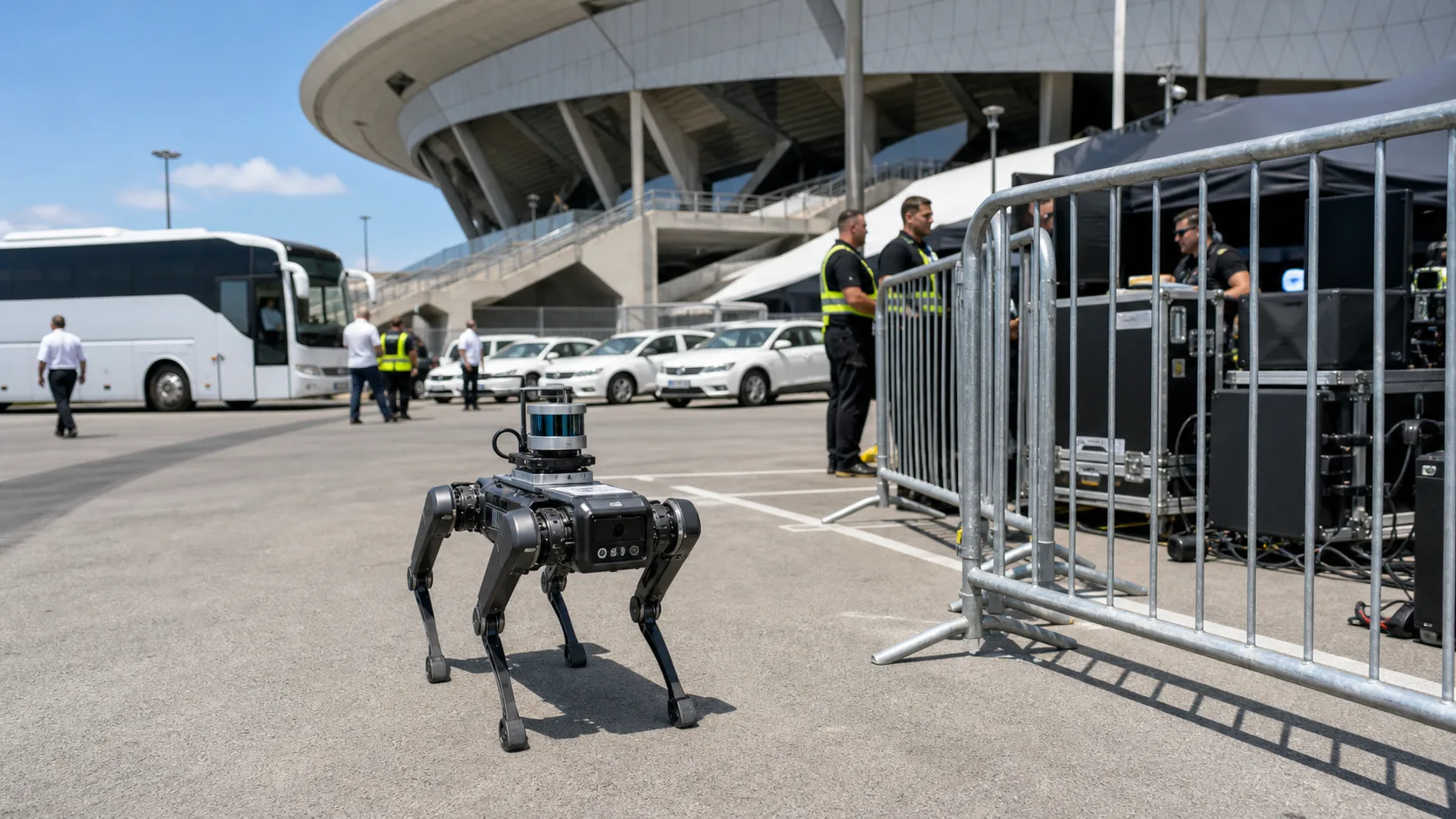
The Spot robots will support autonomous patrol, real-time site monitoring, and inspection at the International Broadcast Center in Dallas and New York-New Jersey Stadium.
The move matters because it connects Hyundai's long-running FIFA mobility role with its newer robotics strategy after taking a controlling stake in Boston Dynamics.
Why This Matters
Large sports events are logistics machines. Teams, officials, media, broadcast crews, equipment, security staff, and spectators all move through temporary systems that must work reliably across long days and crowded sites.
That makes FIFA World Cup 2026 a useful test case for robotics in public infrastructure. A robot does not need to replace a human worker to be valuable. It can collect repeatable visual data, inspect routes, patrol restricted zones, or give operators another view of a site without sending a person into every location.
Spot is already known as a legged inspection robot for industrial and public-safety-style environments. At the World Cup, Hyundai is positioning it as part of a broader event operations stack rather than a standalone novelty.
What Hyundai Is Deploying
Hyundai's mobility fleet will include 994 passenger vehicles and 506 buses. According to the company, the vehicles will support national teams, officials, tournament operations, and media across 16 host cities in the United States, Canada, and Mexico.
The named passenger models include Palisade, Santa Fe, Tucson, Santa Cruz, Kona, Sonata, Elantra, Creta, Creta Grand, and Genesis GV80. Hyundai said hybrid electric variants will be available on select models.
The robotics deployment is much smaller: four customized Boston Dynamics Spot robots. Hyundai says they will be used at two locations:
- International Broadcast Center in Dallas
- New York-New Jersey Stadium
The listed functions are autonomous patrol operations, real-time site monitoring, and inspection. Hyundai also says the robots will be powered by an Enterprise Asset Management kit with industrial inspection and Enterprise Asset Management applications.
That wording suggests an operations role focused on observing, checking, and reporting, not a fan-facing entertainment robot or a general-purpose security replacement.
Why Spot Fits This Kind Of Work
Wheeled robots work well on smooth floors. Drones can cover open space quickly. A quadruped robot sits between those categories.
Spot can move through spaces designed for people, including ramps, uneven ground, narrow passages, and temporary event infrastructure. That is useful at stadiums and broadcast facilities where the environment may change from day to day.
For operators, the value is repeatability. A robot can run the same patrol route, capture comparable images or sensor data, and flag issues for humans to review. In a busy event setting, that can help teams notice blocked access points, equipment changes, or areas that need inspection.
The deployment also gives Hyundai a public example of robotics as part of mobility. Instead of presenting cars, buses, and robots as separate businesses, the company is showing them as tools for moving people, monitoring spaces, and supporting operations.
The Atlas Campaign Is Different
Hyundai's FIFA World Cup 2026 robotics story also includes Boston Dynamics' humanoid robot Atlas, but Atlas is being used differently.
In late May 2026, Hyundai launched a "School of Football" campaign featuring Atlas. The campaign presents Atlas learning football movements through a social film series, including a move Hyundai calls the "Ghost Rabona." Hyundai says the movements were performed by Atlas without CGI, using human motion data, simulation, and reinforcement learning.
That is a communication campaign around physical AI and humanoid movement. The Spot deployment is the operational piece.
Keeping those two roles separate matters. Atlas helps Hyundai tell a story about future humanoid robotics. Spot is the robot being placed in a real event support role at named venues.
Hyundai's Broader Robotics Strategy
Hyundai Motor Group completed its acquisition of a controlling stake in Boston Dynamics in June 2021. The group said at the time that it held 80 percent of Boston Dynamics after the transaction, with SoftBank retaining 20 percent through an affiliate.
Since then, Hyundai has described robotics as part of its move from a traditional carmaker toward a broader smart mobility company. At CES 2022, Hyundai presented ideas such as "Metamobility" and "Mobility of Things," arguing that robotics, AI, autonomous driving, vehicles, and other mobility systems would increasingly overlap.
The World Cup deployment is less futuristic than that language. It is also more concrete. A stadium, a broadcast center, a route, a patrol, and an inspection workflow are easier to evaluate than a concept video.
That is why the event is useful for Hyundai. It can show that Boston Dynamics robots are not only campaign assets or lab machines. They can be part of practical operations, even if the initial scale is small.
What To Watch
The first thing to watch is how visible the Spot robots actually become during tournament operations. Hyundai has named the Dallas International Broadcast Center and New York-New Jersey Stadium, but it has not described detailed patrol schedules, sensor packages, or operator workflows.
The second question is whether FIFA, venue operators, or event contractors report measurable benefits. Useful metrics could include inspection time saved, incidents detected, areas covered, or reductions in risky manual checks.
The third question is whether this deployment leads to repeat use. A four-robot World Cup deployment can be a public demonstration. It becomes more significant if similar systems appear later in factories, airports, logistics hubs, stadiums, and public infrastructure.
For now, Hyundai's announcement is best read as a combined mobility and robotics showcase. The vehicle fleet handles the proven part of the job. Spot gives Hyundai a visible way to test and market robotics in a real operating environment.
FAQ
How many Boston Dynamics Spot robots will Hyundai deploy for FIFA World Cup 2026?
Hyundai says it will deploy four customized Spot robots.
Where will the Spot robots be used?
Hyundai named two locations: the International Broadcast Center in Dallas and New York-New Jersey Stadium.
What will the robots do?
Hyundai says the robots will support autonomous patrol operations, real-time site monitoring, and inspection.
Is Atlas being deployed for operations too?
Hyundai's June 5 deployment announcement specifically lists Spot robots for venue support. Atlas is part of Hyundai's separate FIFA World Cup 2026 campaign content and robotics storytelling.
Why is Hyundai involved with Boston Dynamics?
Hyundai Motor Group completed a controlling acquisition of Boston Dynamics in June 2021 and said it held an 80 percent stake after closing.