Introduction
Amazon's newest warehouse robots show where logistics automation is heading. The next step is not just more machines in more buildings. It is a shift toward robots that can sense physical contact, coordinate as fleets, and fit into real fulfillment workflows instead of working as isolated tools.
That matters because warehouses are built from many small decisions: where to store inventory, which tote to move, which item to pick, which worker to assist, and how to avoid congestion. AI is becoming useful in logistics when it can improve those decisions at scale.
Quick Answer
Amazon's AI warehouse robots point to a more integrated model of automation.
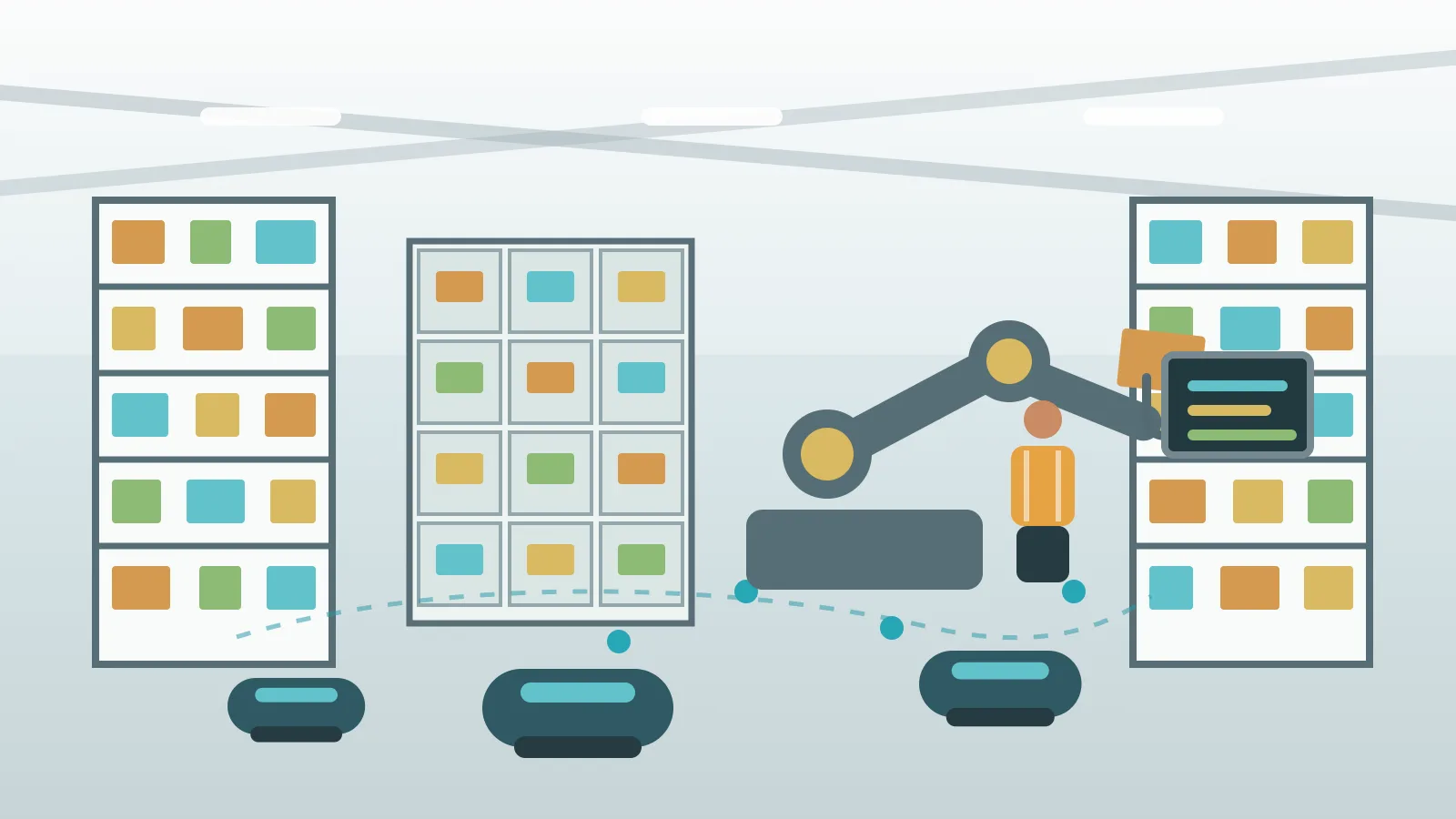
Mobile robots move inventory and carts. Robotic arms pick, stow, and sort items. AI systems coordinate traffic, forecast demand, and help operators understand bottlenecks. The goal is a warehouse where machines handle more repetitive movement while people supervise, maintain, troubleshoot, and handle exceptions.
Why This Matters
Warehouse automation used to be mostly about moving goods faster. A mobile robot could bring a shelf to a worker. A conveyor could move parcels through a sorting area. A fixed robotic arm could repeat a narrow motion.
Amazon's recent robotics work shows a wider goal. The company is combining mobile robots, robotic arms, tactile sensing, computer vision, simulation, and AI models into connected systems. Each piece matters less than the workflow it supports.
For the logistics industry, this is a useful signal. Automation is moving from single-task machines toward systems that coordinate inventory, labor, robot motion, and exception handling inside the same operating loop.
From Mobile Robots To Coordinated Fleets
Amazon has been building warehouse robotics since its 2012 acquisition of Kiva Systems. That early model made goods-to-person fulfillment more practical: robots moved storage pods across the floor so employees could pick items without walking long distances.
The current model is broader. Amazon said on June 30, 2025 that it had deployed its one millionth robot across a network of more than 300 facilities. It also announced DeepFleet, a generative AI foundation model designed to coordinate the movement of its mobile robot fleet and improve robot travel efficiency by 10%.
That detail is important. A warehouse with thousands of robots does not only need better hardware. It needs traffic control. If robots block each other, take inefficient paths, or wait too long at congested stations, the whole building slows down.
DeepFleet suggests that logistics automation is becoming a fleet optimization problem. The value comes from reducing small delays across a very large number of robot movements.
Why Touch Changes The Picking Problem
Picking and stowing are harder than moving a shelf. A warehouse stores many object types: boxes, bags, bottles, books, soft goods, fragile items, and odd shapes. Robots need to know what they are touching, how much force to apply, and when to stop.
That is why Amazon's Vulcan robot is notable. Introduced in 2025, Vulcan is Amazon's first robot with a sense of touch. Amazon says it uses force feedback sensors, computer vision, and physical AI to pick and stow items in storage pods.
The job is practical rather than futuristic. Vulcan is aimed at hard-to-reach locations, including high and low parts of storage pods, so workers can spend less time using step ladders or bending into less comfortable positions. Amazon says Vulcan can pick and stow about 75% of the item types stored in its fulfillment centers and can ask for human help when it cannot handle an item.
This shows a realistic path for warehouse robotics. The robot does not need to solve every manipulation problem. It needs to solve a large enough share of repetitive work while handing exceptions back to people.
Automation Is Becoming A System, Not A Robot
Amazon's Sequoia system is another example. Announced in October 2023, Sequoia combines mobile robots, gantry systems, robotic arms, totes, and an ergonomic workstation. Amazon said it could identify and store received inventory up to 75% faster and reduce the time to process an order through a fulfillment center by up to 25%.
The key point is integration. Sequoia is not one robot replacing one task. It changes how inventory moves through the building. Items are containerized into totes, moved by robots, handled by automation, and presented to workers in a more structured way.
That is likely how many logistics sites will automate. Instead of dropping a humanoid or arm into an unchanged warehouse, operators redesign the workflow so robots, containers, software, and people can work around shared assumptions.
AI Is Reaching Beyond The Warehouse Floor
Amazon's logistics AI work is not limited to robots. In June 2025, the company announced AI systems for delivery location mapping, demand forecasting, and robotics. Its demand forecasting model is designed to predict what products customers want, where they want them, and when. Its robotics work includes agentic AI capabilities so robots can better understand natural language commands.
This matters because fulfillment speed depends on upstream and downstream decisions. If inventory is stored closer to likely demand, robots have less distance to cover. If delivery locations are mapped more accurately, routing and handoff become more predictable. If operators can see bottlenecks earlier, a building can respond before delays pile up.
The next step in logistics automation is therefore not only mechanical. It is operational AI connected to physical systems.
The Blue Jay Lesson
Amazon's Blue Jay prototype shows the other side of the story. Amazon introduced Blue Jay and Project Eluna in October 2025. Blue Jay coordinated multiple robotic arms to pick, stow, and consolidate items in one workspace, and Amazon said it was being tested in South Carolina.
But Amazon later updated its own post on February 25, 2026 to say it was no longer using Blue Jay in operations, while the underlying technology would continue to support other programs. TechCrunch reported on February 18, 2026 that Amazon had halted the Blue Jay project after less than six months.
That does not mean warehouse robotics is failing. It means physical AI has a higher bar than software AI. A system has to be fast, reliable, safe, maintainable, space-efficient, and cheaper than alternatives. A promising prototype can still be the wrong deployment package.
For readers, Blue Jay is a useful caution. The industry should watch what gets scaled, not only what gets demonstrated.
What This Means For Logistics Automation
Amazon's robotics strategy points to five practical trends.
First, warehouses will use more mixed fleets. Mobile robots, robotic arms, sensing systems, and operator tools will work together.
Second, AI will focus on coordination. Routing, congestion reduction, forecasting, and exception handling can create value before full autonomy arrives.
Third, manipulation will improve through physical data. Robots like Vulcan need tactile feedback and real-world examples, not only camera images and simulations.
Fourth, human roles will keep changing. Amazon emphasizes safety, training, and technical career paths, but automation also changes labor demand and job design. The most honest view is that both can be true: robots can reduce physically repetitive work while also shifting what human workers are hired and trained to do.
Fifth, deployment discipline matters. The systems that succeed will be the ones that fit warehouse economics, safety rules, maintenance limits, and peak-season pressure.
What To Watch
The most important question is whether tactile manipulation scales beyond controlled tasks. Vulcan's ability to handle a large share of item types is meaningful, but the remaining exceptions still matter in high-volume logistics.
Another question is whether fleet-level AI produces consistent gains across different building layouts. A 10% travel efficiency improvement is valuable at Amazon's scale, but other operators will need to know whether similar systems work with smaller fleets and less data.
Also watch how Amazon handles worker transition. Training programs and new technical roles are real, but they do not automatically answer every labor question. Better ergonomics, safer workflows, and stable employment outcomes need to be measured separately.
The bigger lesson is clear: logistics automation is becoming less about replacing one task with one robot and more about building an intelligent operating system for the warehouse.
FAQ
What is the main point of Amazon's AI warehouse robots?
The main point is integration. Amazon is using AI to coordinate robot fleets, improve picking and stowing, forecast demand, and support warehouse operators.
What makes Vulcan different from earlier warehouse robots?
Vulcan adds tactile sensing. It can detect contact and force, which helps it manipulate items in crowded storage pods more carefully than robots that rely only on vision and fixed motions.
Does Amazon have more than 1 million robots?
Amazon announced on June 30, 2025 that it had deployed its one millionth robot across its operations.
Did Amazon cancel Blue Jay?
Amazon updated its Blue Jay announcement on February 25, 2026 to say Blue Jay was no longer being used in operations. The company said the underlying technology would continue to support employees across its network.
Will warehouse robots replace all workers?
Current warehouse robots still need people for supervision, maintenance, exception handling, process design, and many manual tasks. Automation can reduce some repetitive work while changing the mix of warehouse jobs.