Introduction
NVIDIA is no longer just selling chips to robotics companies. It is trying to become the platform layer for humanoid robots: the compute, models, simulation tools, data workflows, and developer ecosystem that robot builders use before their machines reach factories, labs, or homes.
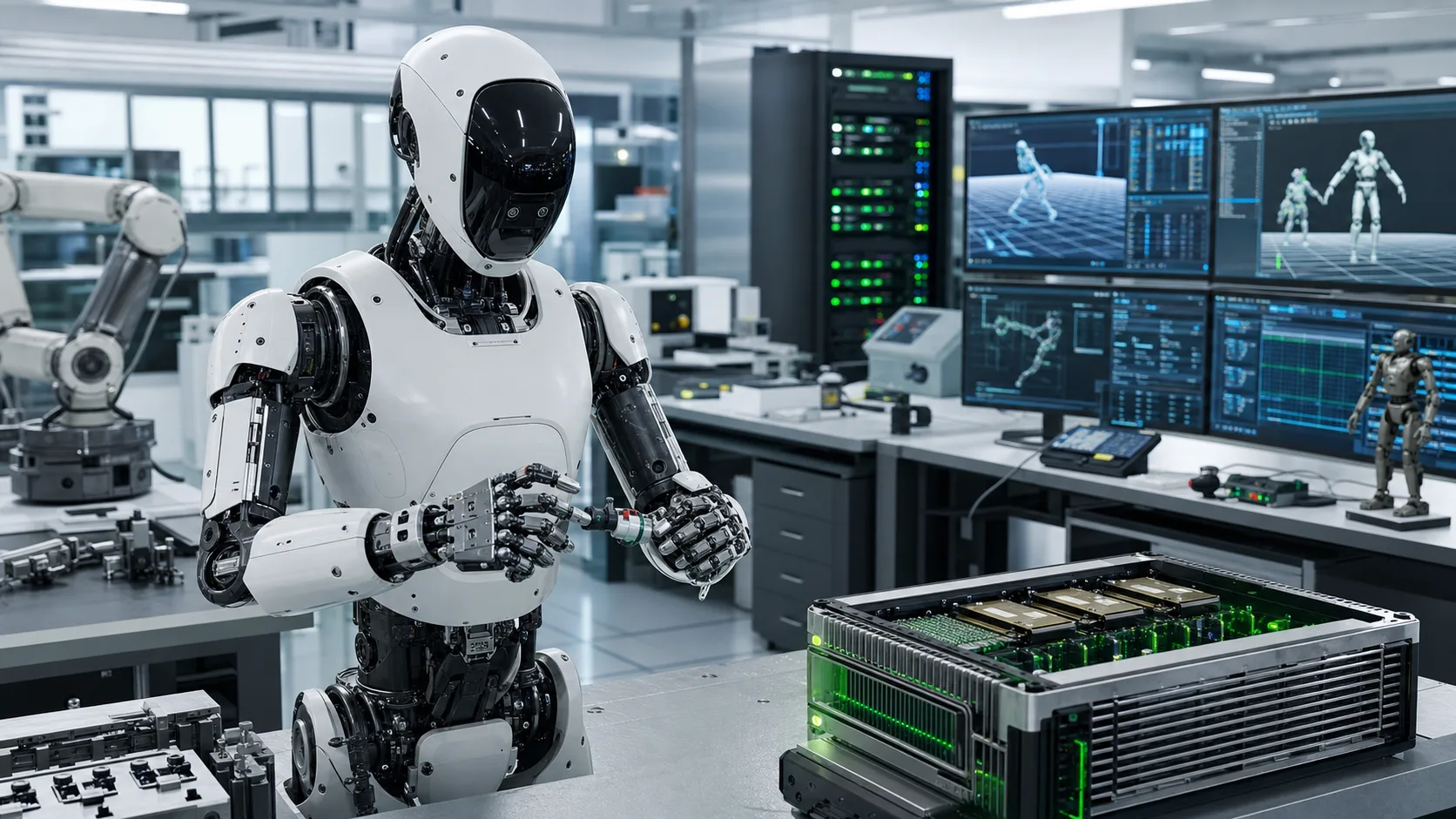
The latest signal came on June 1, 2026, when NVIDIA announced the Isaac GR00T Reference Humanoid Robot for academic research. The reference design combines humanoid hardware, dexterous hands, onboard Jetson Thor compute, and NVIDIA's Isaac GR00T software stack into one research platform.
Quick Answer
NVIDIA is becoming important in humanoid robotics because humanoid developers need more than motors and metal. They need AI models, simulation, synthetic data, real-time edge computing, and tools for evaluating robot behavior.
NVIDIA is packaging those pieces through Isaac GR00T, Isaac Sim, Isaac Lab, Cosmos world models, and Jetson Thor. Its strategy is to make many humanoid companies build on NVIDIA infrastructure, even if NVIDIA does not sell the final robot itself.
Why This Matters
Humanoid robots are difficult because they must combine perception, language understanding, motion control, balance, manipulation, safety, and real-world reasoning. A robot may need to hear an instruction, understand the scene, choose an action, move its whole body, and adjust when objects or people move.
That is a software and compute problem as much as a mechanical one.
This is where NVIDIA has a strong position. The company already dominates much of AI training infrastructure. In humanoid robotics, it is extending that role from cloud AI into physical AI, where models must act in the real world through robot bodies.
The News: NVIDIA's Reference Humanoid Robot
NVIDIA's June 2026 announcement is important because it turns its humanoid robotics stack into a more concrete reference design. The Isaac GR00T Reference Humanoid Robot is aimed at researchers and is expected to be available from Unitree in late 2026.
According to NVIDIA, the system includes a Unitree H2 humanoid chassis, Sharpa Wave tactile five-finger hands, multi-view sensing, and Jetson AGX Thor T5000 onboard compute. The software side includes Isaac Teleop for collecting demonstrations, Isaac GR00T open models, Isaac Sim and Isaac Lab for simulation and training, Isaac ROS for deployment, and Jetson Thor for real-time robot inference and control.
NVIDIA also said Ai2, ETH Zurich, Stanford Robotics Center, and UC San Diego's Advanced Robotics and Controls Laboratory will use the reference design for humanoid robotics research.
That matters because a reference robot can reduce the amount of custom integration each lab must do before testing new robot learning ideas. It does not solve humanoid robotics by itself, but it can make experimentation more repeatable.
NVIDIA Wants To Own the Robotics Stack
The clearest way to understand NVIDIA's strategy is to look at the full stack:
1. Models for robot reasoning
Isaac GR00T is NVIDIA's model family for humanoid robot reasoning and skills. In March 2025, NVIDIA introduced GR00T N1 as an open foundation model for humanoid robots. In 2026, it expanded the line with GR00T N1.7, described as an open reasoning vision-language-action model with commercial licensing for humanoid deployments.
A vision-language-action model, or VLA, connects what a robot sees, what a human asks, and what the robot should do. For a humanoid, this can mean turning visual context and instructions into arm, hand, and body actions.
2. Simulation before real-world testing
Humanoid robots are expensive to train directly in the real world. They can fall, damage objects, or create safety risks. NVIDIA's Isaac Sim and Isaac Lab are designed to let developers test and train policies in simulation before deploying them on physical robots.
This is not a replacement for real-world data. It is a way to reduce the cost and risk of early training and evaluation.
3. Synthetic data generation
Robot learning needs large amounts of task data. NVIDIA has been pushing synthetic data workflows through GR00T-related blueprints and Cosmos world models. The goal is to create more training examples for manipulation, movement, and reasoning without relying only on human teleoperation.
This is especially important for dexterous manipulation. Hands, objects, lighting, and contact forces create many edge cases that are hard to collect manually at scale.
4. Edge compute on the robot
Jetson Thor is NVIDIA's robotics computer for running AI workloads on physical machines. In humanoids, onboard compute is critical because a robot cannot send every perception and control decision to the cloud. It needs fast local inference for balance, perception, manipulation, and safety.
By putting Jetson Thor inside reference designs and partner robots, NVIDIA can make its hardware the default compute layer for physical AI.
5. Ecosystem partnerships
NVIDIA is also building influence through partners. In March 2026, it said robotics companies and industrial automation players including ABB Robotics, Agility, Boston Dynamics, Figure, KUKA, Universal Robots, Yaskawa, and others were building with NVIDIA technologies.
This does not mean all of those companies are using the same NVIDIA product in the same way. It does show that NVIDIA is positioning itself as infrastructure for many parts of the robotics market, from humanoids to industrial automation and surgical systems.
Why Humanoid Companies May Use NVIDIA
Most humanoid startups do not want to build every layer from scratch. Their hard problems are already broad: body design, actuators, batteries, hands, safety, remote operations, reliability, manufacturing, and customer deployment.
If NVIDIA can provide a credible development stack, robot companies can focus more on the body, use case, and customer workflow.
This is similar to NVIDIA's role in AI data centers. Many AI companies compete at the application or model layer, but they still train on NVIDIA GPUs. In humanoid robotics, NVIDIA is trying to make Isaac, GR00T, Cosmos, and Jetson the common foundation beneath many competing robots.
What NVIDIA Does Not Yet Control
NVIDIA's position is strong, but it is not the whole humanoid robotics market.
It does not control the final customer relationship for most humanoid robots. It does not manufacture most robot bodies. It does not solve hardware reliability, cost, battery life, safety certification, or factory integration on its own.
There is also competition from robotics labs, robot startups, industrial automation companies, open-source frameworks, and large AI companies developing their own embodied AI systems.
The big question is whether NVIDIA's stack becomes a default layer or just one option among many.
What To Watch
The first thing to watch is availability. NVIDIA says the Isaac GR00T Reference Humanoid Robot will be available from Unitree in late 2026, while a Unitree G1 reference workflow is expected sooner on GitHub and Hugging Face.
The second thing to watch is adoption beyond research. A lab reference design is useful, but the larger business opportunity depends on whether industrial humanoid developers use the same stack in commercial deployments.
The third thing to watch is model performance. Humanoid robotics will need models that can handle messy, changing physical environments. Demos are useful, but reliability across thousands of real tasks is the harder test.
FAQ
Is NVIDIA building its own humanoid robot?
NVIDIA has announced a humanoid reference design for research, not a consumer or industrial humanoid product line like a robot manufacturer would sell. Its larger strategy is to provide the compute and software platform that many humanoid developers can use.
What is Isaac GR00T?
Isaac GR00T is NVIDIA's humanoid robotics model and development platform. It includes robot foundation models and workflows for data collection, simulation, training, evaluation, and deployment.
Why is Jetson Thor important for humanoid robots?
Jetson Thor is designed to run AI workloads on robots at the edge. Humanoids need onboard compute because many perception and control decisions must happen quickly and locally.
Does this mean NVIDIA will dominate humanoid robotics?
Not automatically. NVIDIA has a strong platform strategy, but humanoid robotics still depends on hardware reliability, safety, cost, customer demand, and real-world performance. NVIDIA is becoming a key infrastructure player, not the only company that matters.