Robots come in many shapes and sizes. Some look like human arms; others are little wheeled boxes that bring you pizza. There are even robots that fly like birds or swim like fish. This guide walks through the major categories of robots, using everyday examples and analogies so you can easily understand how each type works and what it’s for.
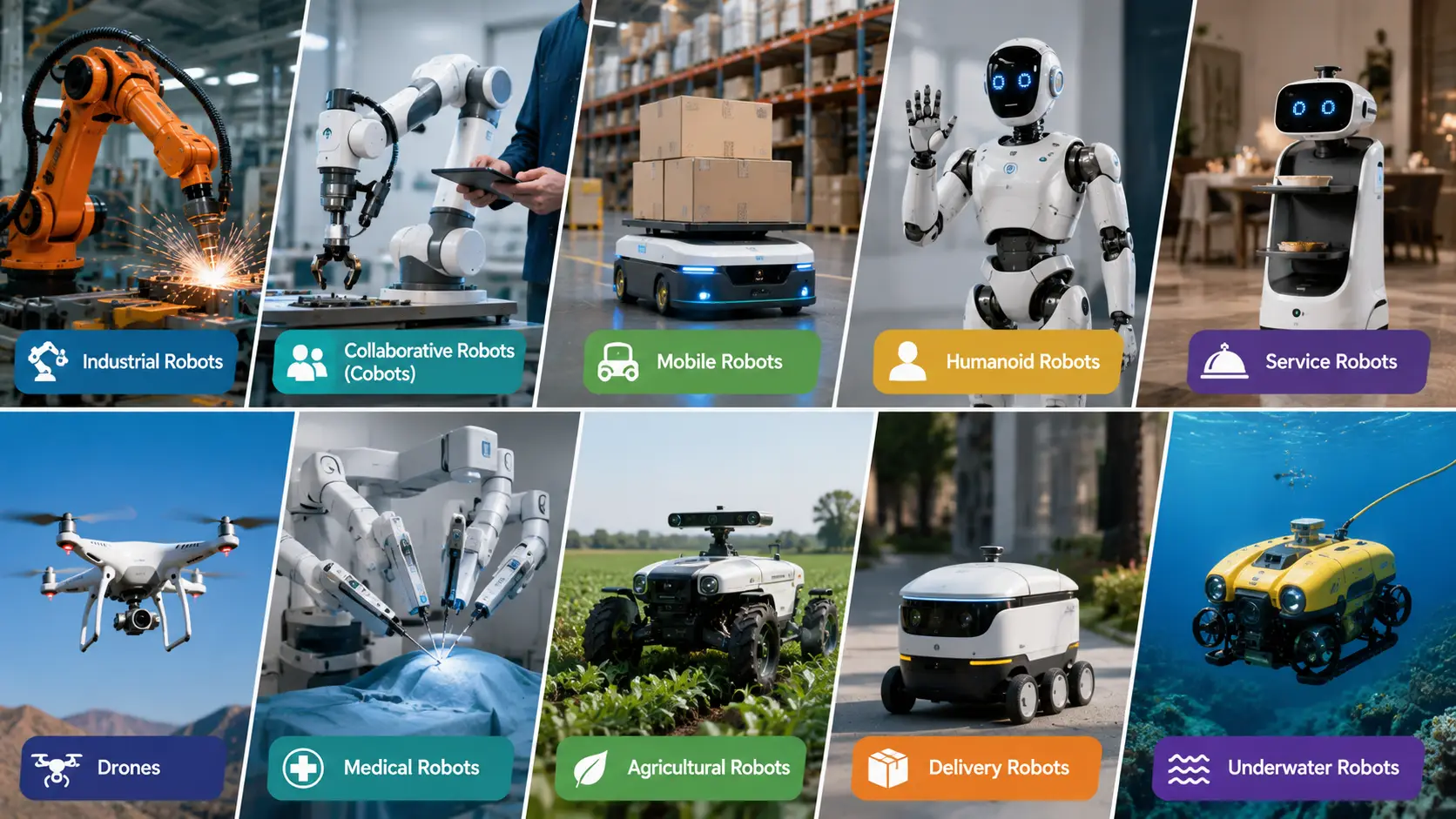
What Are Robot Types?
Think of robot types like different breeds of dogs. All dogs belong to the same species but are bred for different jobs—some herd sheep, some retrieve ducks, and others curl up on your lap. In the same way, all robots follow the basic pattern of sensing, thinking and acting, but their shapes and abilities are tuned for specific tasks.
Below you’ll find the most common categories of robots, from factory workhorses to household helpers.
Industrial Robots
Industrial robots are built for manufacturing and production. They work in factories and can weld, paint, assemble parts and move heavy items with speed and precision. Common sub‑types include:
-
Articulated Robots – These robots have rotating joints like a human arm. An articulated robot may have four, six or more axes that allow it to reach around corners, under overhangs and into machine tool compartments. Their flexibility makes them ideal for machine tending or welding, but their complex joints make them heavier and more expensive.
-
SCARA Robots – SCARA stands for Selective Compliance Articulated Robot Arm. Picture a human arm limited to moving within two parallel planes, like shuffling pieces on a checkerboard. SCARA robots are lightweight and excel at fast, precise vertical assembly tasks such as inserting pins into circuit boards.
-
Delta Robots – Delta robots look like spiders, with three or more arms anchored at the base and a lightweight wrist at the end. Because their motors sit on the base rather than in the arm, they move very quickly and are perfect for high‑speed pick‑and‑place operations with small items. Their reach is defined by the diameter of their working range rather than how far they extend.
-
Cartesian Robots – Also known as gantry robots, these robots move along straight lines using multiple linear actuators assembled above a workspace. They can be scaled up to cover large areas and handle heavy parts. Because they use standard components, they are often cost‑effective, though they have limited ability to reach around obstacles.
Industrial robots are highly precise and can work around the clock, making them essential for mass production.
Service Robots
Service robots are designed to help people outside of manufacturing. The International Federation of Robotics defines a service robot as an actuated mechanism with two or more axes that moves in its environment to perform useful tasks for humans or equipment, excluding industrial automation. Service robots don’t produce goods but provide a service, like delivering food or disinfecting rooms.
IFR distinguishes between consumer service robots, which anyone can operate, and professional service robots, which require trained operators. Examples include:
- Domestic robots like vacuum cleaners and lawn mowers that tidy up your home.
- Delivery robots that navigate sidewalks or hospital corridors to bring meals, packages or lab samples.
- Medical robots that assist surgeons by holding tools steady and monitoring patient vitals, improving precision and reducing fatigue.
- Agricultural robots that plant seeds, harvest crops and remove weeds, helping farmers manage large fields.
Mobile Robots
Mobile robots move through their environment rather than staying in one place. They include autonomous vehicles, drones and other machines that navigate on wheels, tracks or legs. According to UTI’s guide, mobile robots rely on advanced navigation systems and sensors to travel and perform tasks independently.
Two common mobile sub‑types are:
-
Autonomous Mobile Robots (AMRs) – These robots roam freely using sensors and onboard processing to map their surroundings and make decisions. They’re used in warehouses and hospitals to transport goods without requiring a pre‑set path.
-
Automated Guided Vehicles (AGVs) – AGVs follow defined routes marked by tape, magnets or wires. They usually need more oversight and are less flexible than AMRs, but they are reliable for repetitive, predictable tasks like shuttling pallets across a factory floor.
Mobile robots also include drones that fly through the air and underwater robots that explore the deep.
Collaborative Robots (Cobots)
Collaborative robots, or cobots, are built to work safely alongside humans. They have force sensors and speed limits so that a bump from a person won’t cause injury. Cobots are popular in manufacturing, healthcare and logistics because they can handle repetitive or heavy tasks while people focus on skilled work. UTI notes that cobots reduce the risk of injury and increase productivity by assisting workers.
Humanoid Robots
Humanoid robots resemble the human body. They typically have a torso, two arms and two legs and may imitate facial expressions. Intel explains that humanoid robots take human‑like form and perform human‑centric functions such as operating tools designed for people. Building humanoids is challenging because walking, balancing and manipulating objects with human grace requires complex sensors and control systems.
Consumer and Companion Robots
Consumer robots are designed for everyday people. They can help with chores, offer entertainment or serve as companions. Examples include:
- Vacuum cleaners and lawn mowers that clean floors and yards on their own.
- Companion robots like robotic pets or social bots that provide company. RobotsGuide describes consumer robots as devices you can buy to complete specific tasks or provide fun; examples include Roomba, Tertill, Aibo and Lovot.
- Educational kits like programmable blocks and robots from companies such as Cubelets, Dash and Dot or Lego; these teach kids coding and problem‑solving.
Delivery Robots
Delivery robots specialize in transporting items. They use cameras, GPS and other sensors to navigate streets and hallways. Some operate outdoors, delivering groceries or take‑out, while others move through hospitals. RobotsGuide notes that examples include Starship’s sidewalk robots, Savioke’s Relay robot and Zipline’s medical drones.
Disaster Response Robots
When disasters strike, specialized robots go where humans cannot. These rugged machines search for survivors in rubble, assess damage in radioactive zones and traverse hazardous terrain. RobotsGuide highlights PackBot, Kobra and Quince robots that are built to withstand extreme conditions and can climb stairs or operate in nuclear reactors.
Drones
Drones are flying robots. Many hobby drones are quadcopters—four‑rotor aircraft that can hover and maneuver in tight spaces. Some drones require human pilots, while more advanced models navigate autonomously. RobotsGuide explains that consumer drones like DJI’s Phantom can capture aerial photos and track moving subjects.
Educational Robots
Educational robots are tools for learning. They range from simple kits that teach children how to build and code robots to sophisticated platforms used by researchers. Examples include Cubelets, Dash and Dot and Root, as well as Lego robotics kits. These robots make robotics concepts tangible and fun.
Entertainment Robots
Entertainment robots are designed to amuse and engage. They might tell jokes, play games or perform on stage. RobotsGuide describes how robot actors like RoboThespian and animatronics at theme parks entertain audiences. Swarms of micro‑drones can also create spectacular aerial light shows.
Medical and Healthcare Robots
Robots are transforming healthcare. Brainlab’s overview lists several categories:
- Surgical robots assist surgeons by holding instruments steady and positioning tools precisely.
- Robotics for radiotherapy use robotic arms to move linear accelerators around patients, delivering targeted radiation treatment.
- Rehabilitation robots provide controlled, repetitive movement to help patients regain mobility.
- Capsule endoscopy uses pill‑sized robots that patients swallow; these tiny cameras travel through the digestive tract and avoid the need for sedation.
- Laboratory robots automate tasks in labs, such as handling chemicals and processing samples, improving speed and accuracy.
- Robotic prosthetics and exoskeletons offer life‑like limb function and allow people with mobility impairments to walk.
- Hospital robots deliver medications and disinfect rooms, reducing human exposure to pathogens.
- Telepresence and social robots enable doctors to interact with patients remotely and provide companionship or cognitive support.
Agricultural Robots
Agricultural robots are service robots that work on farms. IFR notes that they address labor shortages and environmental challenges by planting seeds, weeding and harvesting crops. Drones monitor crop health and irrigation, while autonomous tractors and harvesters handle heavy tasks.
Putting It All Together
Robots are as diverse as the jobs they do. From the precise articulated arms in factories to the friendly social bots in hospitals, each type of robot is designed for a particular role. Understanding these categories can help you appreciate how robots are woven into everyday life and where the field might be heading next.