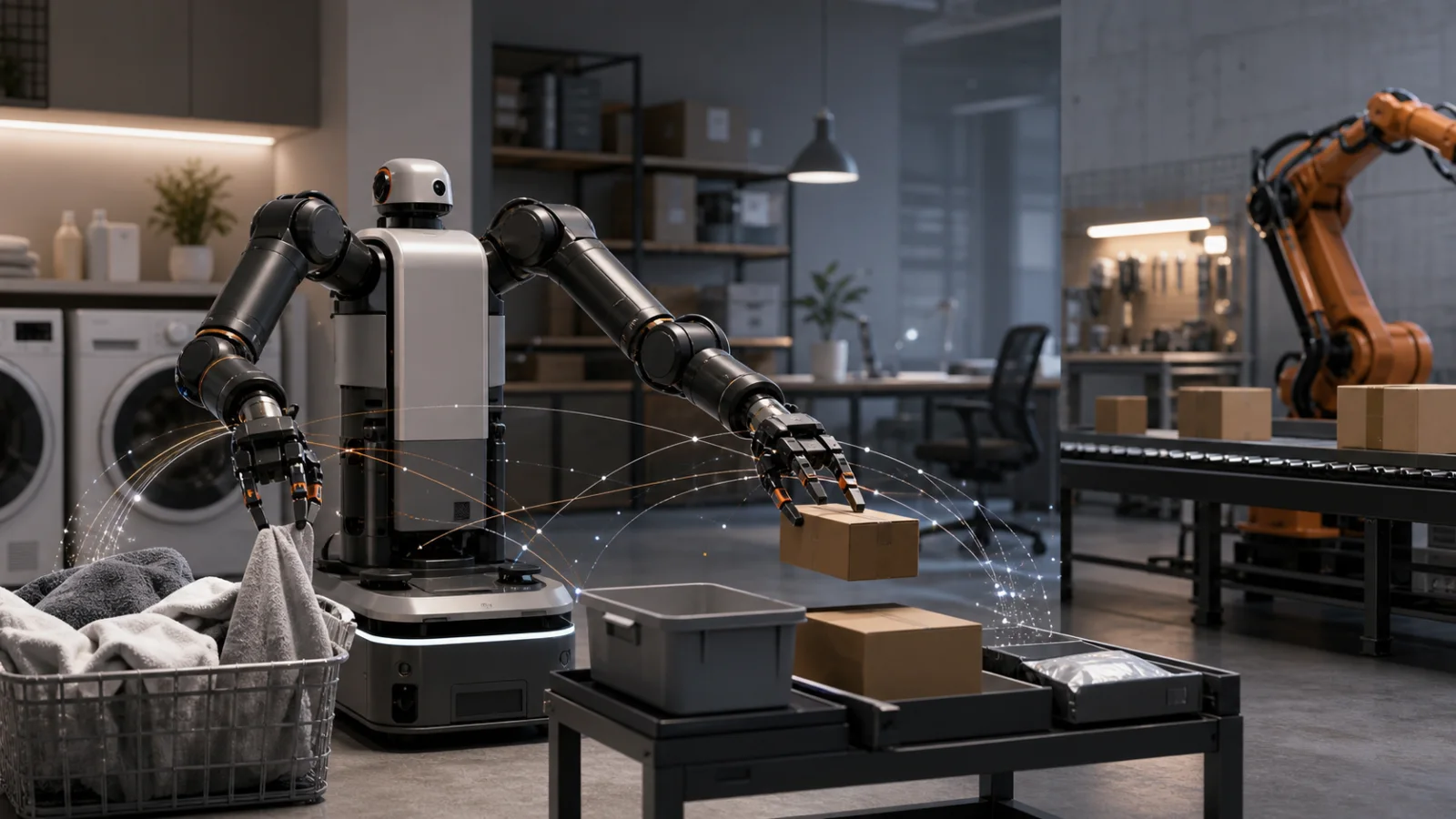
Xiaomi-Robotics-1 Scales VLA Training to 100K Hours
Xiaomi Robotics has released Xiaomi-Robotics-1, a vision-language-action model trained with more than 100,000 hours of real-world manipulation trajectories. The accompanying research asks a central question for general-purpose robotics: can robot policies improve predictably when their data and model size grow?
Quick Answer
- Pre-training uses over 100,000 hours of UMI manipulation trajectories from more than 1,700 scenarios.
- A second stage aligns the model to real robot embodiments and human-style instructions.
- Xiaomi reports better results as both data volume and model size increase.
- The model and code are available under Apache 2.0, but the reported results are produced by Xiaomi's own team.
Why the Data Collection Method Matters
Robot learning has a data problem. Internet-scale text and images are abundant, while collecting diverse robot demonstrations is slow and expensive. Xiaomi's approach uses the Universal Manipulation Interface, or UMI, to record manipulation trajectories without requiring a robot to perform every demonstration.
The pre-training corpus covers homes, offices, commercial spaces, industrial sites and outdoor environments. An automated pipeline segments the trajectories and labels the visible state changes in language. This turns physical demonstrations into paired examples of what the world looks like, what change is requested and which actions produce that change.
The distinction is important: 100,000 hours of UMI trajectories are not the same as 100,000 hours of autonomous robot operation. They are a large source of real-world manipulation experience used for pre-training.
From General Motion to Robot Instructions
Xiaomi-Robotics-1 combines a vision-language model with a diffusion transformer that predicts actions. After broad pre-training, the team uses cross-embodiment post-training data from UMI devices, fixed robot arms and mobile manipulators. The paper reports more than 7,200 hours of robot data in this alignment stage.
This two-stage recipe is designed to separate two jobs. Pre-training learns broad action patterns from diverse scenes, while post-training connects that knowledge to specific robot bodies and imperative instructions such as packing an item or loading laundry.
The team evaluated 2-billion, 5-billion and 10-billion parameter variants. Its experiments show lower action-prediction error with more pre-training data, and higher out-of-the-box task success as model size rises. On four tasks in unseen environments, the reported overall success rate increased from 61% for the 2B model to 75% for 5B and 79% for 10B.
What the Downstream Tests Show
The researchers also fine-tuned the model for phone packing, printer refilling, laundry loading and box packing. With fewer than 10 hours of demonstrations per task on average, Xiaomi-Robotics-1 reached a reported 75% overall success rate, compared with 40% for the team's implementation of the π0.5 baseline. With more task data, the model reached 85% overall.
These results suggest that broad manipulation pre-training can reduce the amount of task-specific data needed later. They do not prove that one policy can reliably run an unrestricted home or factory. The evaluations cover defined tasks, controlled success criteria and a limited number of trials.
Why This Matters
The most useful contribution may be evidence that robotics can benefit from scaling without collecting every training example on the final machine. If UMI-style collection, automatic labeling and cross-embodiment alignment continue to work at larger scales, teams could build reusable data foundations before a production robot design is frozen.
The open release also gives researchers a chance to test the claims on different hardware and benchmarks. Independent reproduction will matter, especially for contact-rich, long-horizon tasks where small environmental changes can cause failures.
What To Watch
Watch for results outside Xiaomi's own evaluation setup, including new embodiments and longer continuous deployments. It will also be important to measure failure recovery, safety and inference cost—not only task completion.
The paper makes a strong case that data volume is becoming a first-class robotics engineering variable. The next test is whether that scaling produces durable capability in messy, changing workplaces.
FAQ
What is Xiaomi-Robotics-1?
It is a vision-language-action foundation model for mobile manipulation, designed to follow language instructions in unfamiliar environments and adapt to new tasks with limited fine-tuning data.
Was the model trained on 100,000 hours of robot operation?
No. The large pre-training dataset consists primarily of real-world manipulation trajectories collected with UMI devices. The paper separately reports more than 7,200 hours of post-training robot data.
Is Xiaomi-Robotics-1 open source?
Xiaomi has published the project repository and model resources under the Apache 2.0 license.