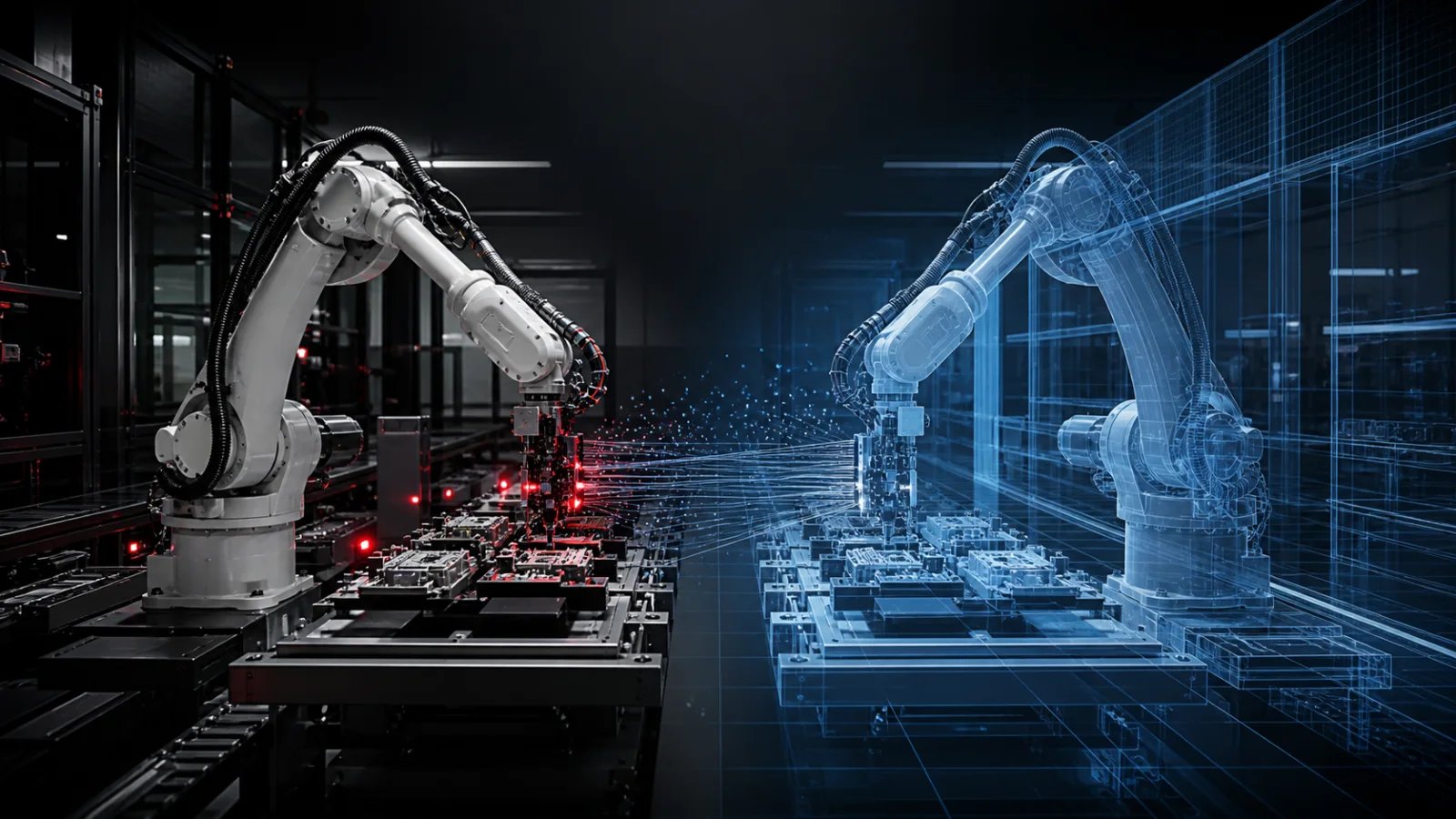
ABB and NVIDIA Outline a Physical AI Factory Loop
ABB Robotics and NVIDIA have published a white paper proposing a repeatable engineering workflow for physical AI in precision manufacturing. Rather than treating an AI model as a component that can be dropped into a production line, the approach connects digital twins, synthetic data, virtual validation and real operating feedback.
Quick Answer
- The workflow moves vision-risk analysis and AI validation earlier into digital engineering.
- Synthetic and real data are connected through a Real2Sim2Real feedback loop.
- RobotStudio HyperReality integrates NVIDIA Omniverse libraries with ABB's simulation and virtual-controller stack.
- ABB says the product will reach more than 60,000 RobotStudio users in the second half of 2026 after selected customer trials.
Why Physical AI Needs an Engineering Process
Traditional industrial automation works best when products, fixtures and motions are predictable. AI-based perception can help robots handle variation, but it also introduces uncertainty: lighting changes, reflections, unusual parts and occlusion can alter what a model sees.
ABB and NVIDIA argue that these risks should be addressed before equipment reaches the factory floor. Their proposed process builds a digital twin of the task, generates task-specific synthetic data, trains or adapts perception models, and validates robot behavior across virtual variations. Real production data then updates the model and simulation.
This is less a single algorithm than a lifecycle. It aims to make data, model versions, validation evidence and robot behavior traceable as an application moves from concept to deployment.
The Real2Sim2Real Loop
In a Real2Sim2Real workflow, engineers first use real requirements and observations to build a useful simulation. The virtual environment can then produce controlled variations in part position, camera angle, material appearance and lighting. Models trained or tested in that environment return to the physical system, where new operating data reveals remaining gaps.
Those gaps feed the next simulation cycle. The loop matters because neither synthetic nor real data is sufficient by itself. Synthetic data can cover rare cases cheaply, while real measurements expose friction, sensor noise and process variation that the simulator may miss.
The white paper places robotic vision at the entry point because perception failures often propagate into planning and motion. Discovering a weak visual model before installation is cheaper than debugging it during line commissioning.
RobotStudio HyperReality
One implementation of the approach is RobotStudio HyperReality. ABB is extending its RobotStudio offline programming environment with NVIDIA Omniverse libraries for photorealistic, physics-based simulation. ABB's virtual controller runs the same firmware used on physical robots, helping engineers compare virtual and real behavior.
ABB says the system can support synthetic-data generation, AI-ready virtual commissioning and physical AI model training. The company advertises up to 99% sim-to-real accuracy, up to 80% shorter setup and commissioning, up to 40% lower engineering and production costs, and 50% faster time to market. These are vendor claims and will depend heavily on the application.
Following customer trials, ABB plans to make HyperReality available to its global RobotStudio community in the second half of 2026. The announcement does not provide public pricing or a precise release date.
Why This Matters
Manufacturers typically demand repeatability, safety evidence and controlled change management. A strong demo is not enough. Physical AI systems need a way to show which data trained a model, which variations were tested and how a software update affects robot behavior.
The ABB-NVIDIA workflow tries to bring AI into familiar industrial engineering disciplines. If it works, the benefit may be faster deployment of adaptable robotic cells without abandoning the validation practices that factories rely on.
The open question is how well the methodology transfers across sensors, robots and third-party models. ABB says its toolchain is intended to support an open AI ecosystem, but real interoperability will have to be demonstrated in production projects.
What To Watch
Watch for independent customer results after the second-half release, especially applications with reflective parts, deformable materials or frequent product changes. These are areas where synthetic variation could help but where sim-to-real gaps remain difficult.
Also watch how ABB reports accuracy. A single correlation figure cannot describe every perception and manipulation failure mode. Useful case studies should disclose task definitions, intervention rates and performance over time.
FAQ
What is RobotStudio HyperReality?
It is an upcoming extension of ABB RobotStudio that integrates NVIDIA Omniverse libraries for photorealistic, physics-accurate simulation, synthetic data and physical AI development.
What does Real2Sim2Real mean?
It is a feedback loop in which real requirements and data improve a simulation, the simulation trains and tests AI systems, and results from physical deployment feed the next virtual cycle.
When will HyperReality be available?
ABB says it plans to make the product available to the RobotStudio community in the second half of 2026, following selected customer trials.