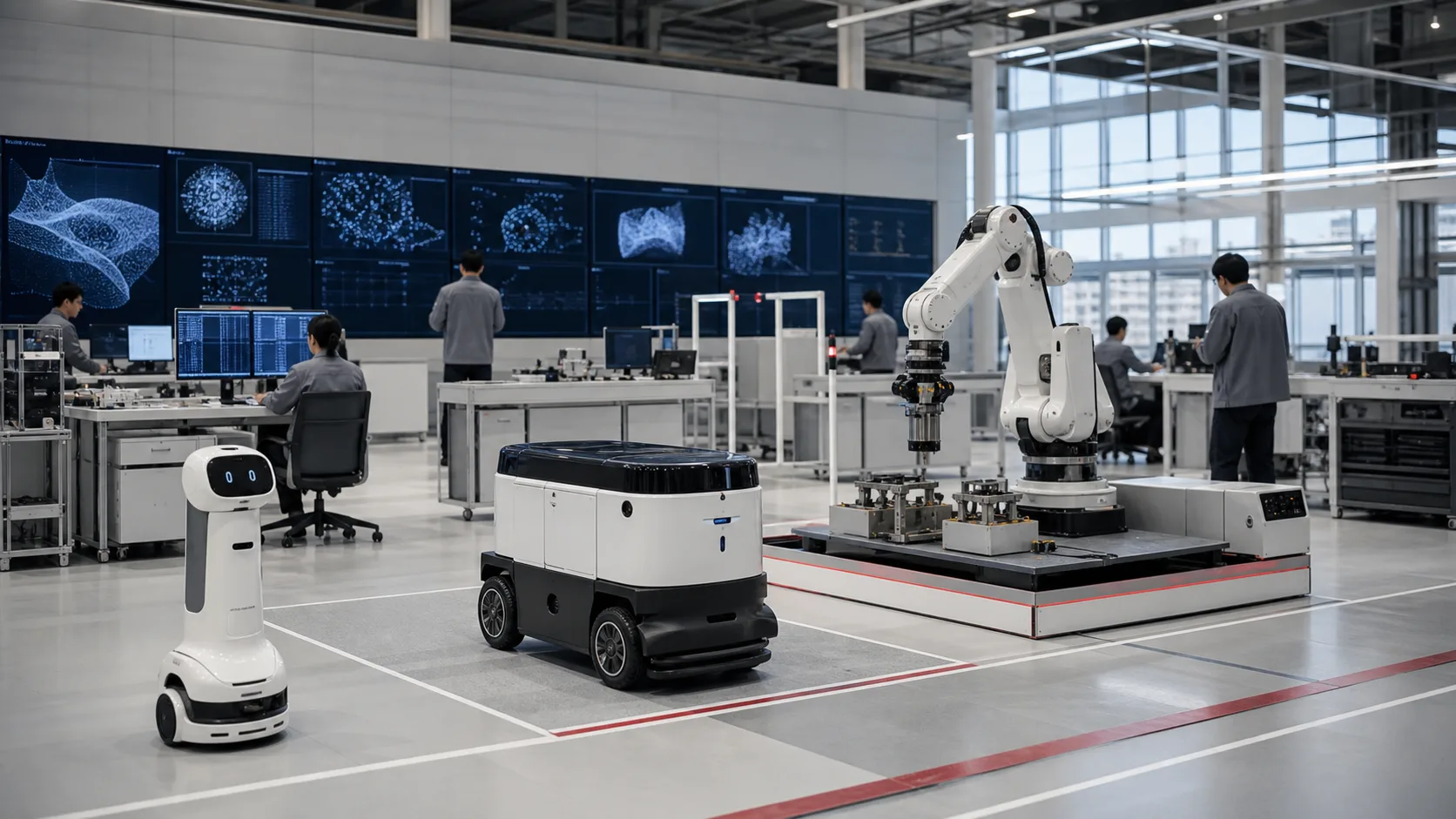
LG Forms Robotics Business Center for Physical AI
LG Electronics has formed a Robotics Business Center that reports directly to its CEO. The new organization brings business development, sales, operations and manufacturing coordination together as LG expands across home, commercial and industrial robotics.
Quick Answer
- The Robotics Business Center became effective on July 1, 2026.
- It reports directly to LG Electronics CEO Lyu Jae-cheol.
- LG is adding a dedicated data factory organization for robot training data.
- The company plans to connect home robots, Bear Robotics, Robostar, actuators and group AI capabilities into one strategy.
Why This Matters
Large electronics companies already own many pieces needed to build robots: motors, sensors, batteries, appliances, manufacturing systems, service networks and AI teams. The difficult part is turning those pieces into products and operations that customers can buy and support.
LG’s new business center is an organizational answer to that problem. Instead of treating robotics as several separate projects, the company is creating an end-to-end unit with responsibility from business development through sales and operations.
The move suggests LG wants robotics to become a commercial business line, not only a research program or a collection of product demonstrations.
A CEO-Level Robotics Organization
The Robotics Business Center reports directly to CEO Lyu Jae-cheol and is led by Song Si-yong, an executive with experience at LG’s Production Engineering Research Institute.
LG says the unit will coordinate business development, sales and operations. It was formed through an off-cycle reorganization four months ahead of the company’s usual annual restructuring, which LG presents as evidence that robotics has become a near-term priority.
This structure should give the robotics group more control over product planning, supply chains, manufacturing and customer deployment. It may also make it easier to combine technology from different LG affiliates.
The Data Factory Is a Key Part
The new center includes a dedicated data factory organization. LG says operational data collected through this work will help improve its Robot Foundation Model, or RFM.
Robot learning requires more than internet-scale text and images. Models need examples of physical tasks, including what the robot sees, which action it takes and whether that action succeeds. Collecting, reviewing and organizing this data is expensive but important for improving robot behavior.
LG is building a large-scale data factory at its Yangjae R&D Campus in Seoul and says operations are scheduled to begin in 2026. The company has not disclosed the size of the training dataset or detailed model benchmarks in this announcement.
A Three-Part Robotics Portfolio
LG describes a strategy spanning residential, commercial and industrial robotics.
For homes, the company has been developing connected home robots and physical AI features that work with its appliance ecosystem. In commercial environments, LG owns a controlling stake in Bear Robotics, known for service and delivery robots. Its industrial position includes Robostar and LG’s experience in factory automation.
LG also wants to supply core components. The company says it is preparing domestic production of robotic actuators, drawing on its long history in motor technology.
This combination gives LG several possible business models: selling finished robots, supplying components, providing robot intelligence and integrating systems across LG Group customers.
What Is Confirmed and What Is Still Open
The new organization, reporting structure and data factory plan are confirmed by LG. The company has also clearly identified robotics as a strategic growth area.
What remains uncertain is how the portfolio will be packaged for customers. LG has not announced revenue targets, unit volumes or a timetable for broad deployment of its home robotics products in this release.
The group also has to prove that its different assets can work as one platform. Owning robot companies, motor expertise and AI research does not automatically create shared software, common hardware interfaces or efficient sales channels.
What To Watch
The first milestone is the start of operations at the Yangjae data factory. The second is whether LG publishes measurable improvements to its Robot Foundation Model or deploys the model across multiple robot types.
It will also be worth watching actuator production and the relationship between LG’s home robots, Bear Robotics and Robostar. If the new center creates reusable technology across all three areas, LG could build a broader robotics platform. If the businesses remain separate, the reorganization may have less practical impact.
FAQ
What is LG’s Robotics Business Center?
It is a CEO-level organization that combines robotics business development, sales, operations and commercialization work.
What is LG’s robotics data factory?
It is a planned operation for collecting and preparing real-world robot data to train and improve LG’s Robot Foundation Model.
Which robotics businesses does LG have?
LG’s announced portfolio includes home robots, commercial robotics through Bear Robotics, industrial robotics through Robostar, robot components and group AI capabilities.