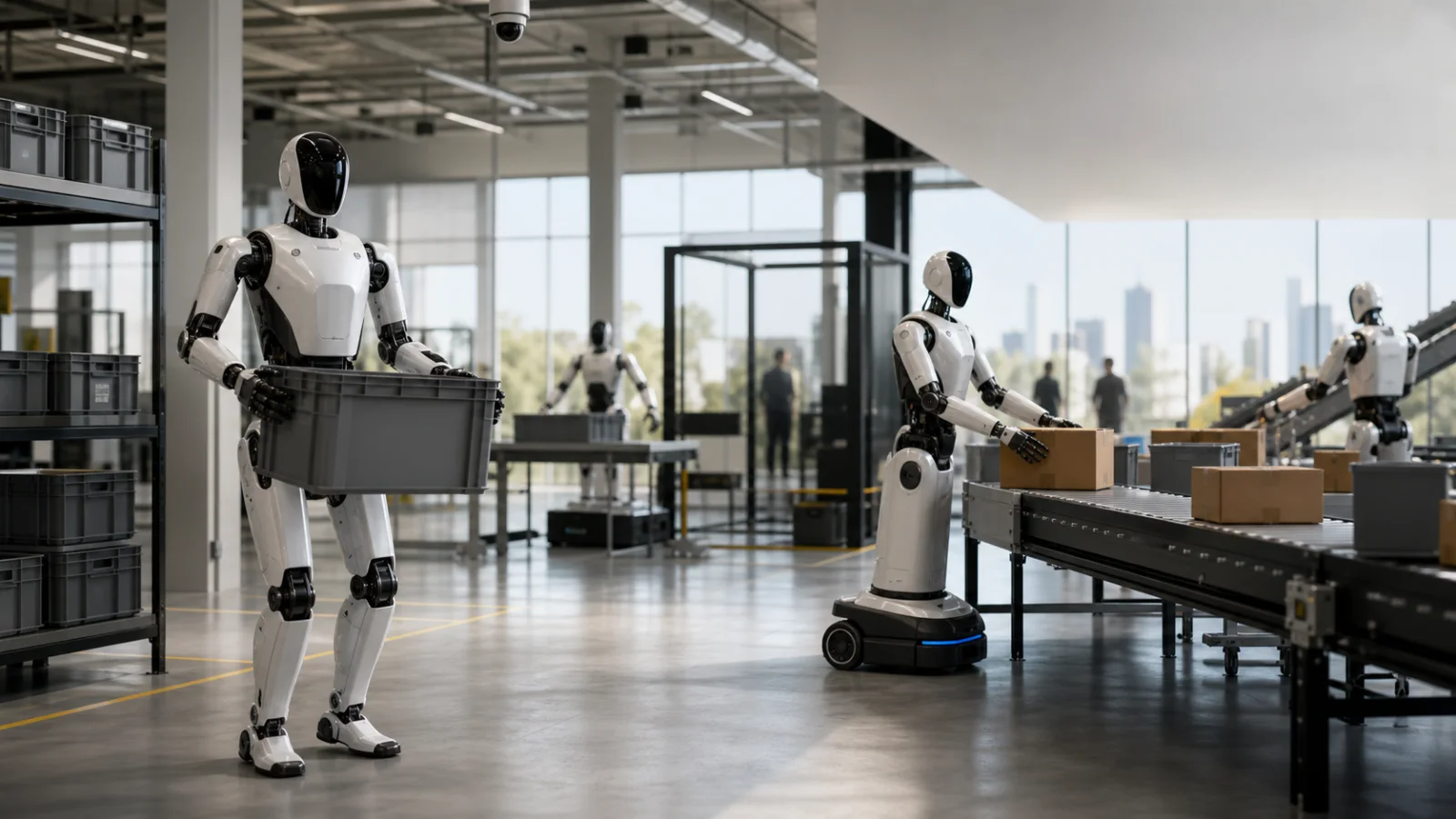
Apptronik Opens Robot Park and Unveils Apollo 2
Apptronik has opened an expanded humanoid data-collection facility in Austin, Texas, and publicly unveiled Apollo 2, the current version of its robot platform. The announcement connects a nearly 90,000-square-foot training floor, modular robot hardware and Google DeepMind's Gemini Robotics models into one development loop.
Quick Answer
- Robot Park is Apptronik's flagship facility for collecting real-world humanoid training data.
- Apollo 2 is available in bipedal and wheeled-base configurations.
- Apptronik says similar data workflows also run at Google DeepMind, Mercedes-Benz and GXO sites.
- Data and operating experience from Apollo 2 are intended to support the future Apollo 3 commercial fleet.
A Training Facility, Not a Conventional Factory
Robot Park is designed to generate experience rather than simply assemble machines. Apollo 2 robots practice customer-driven tasks across logistics, manufacturing and retail setups. The company uses a combination of teleoperation, autonomous execution and simulation to collect training examples.
That focus reflects a broader shift in humanoid robotics. Hardware teams can build stronger actuators and more capable hands, but useful autonomy also requires repeated exposure to objects, layouts and failure cases. A dedicated facility lets engineers reproduce common workflows while still varying the environment enough to train more robust models.
Apptronik describes Austin as the anchor of a wider Robot Park network. It says comparable collection workflows have been deployed with research partner Google DeepMind and customers Mercedes-Benz and GXO. The announcement does not disclose the number of robots, daily data volume or a schedule for opening additional locations.
Why Apollo 2 Has Two Mobility Options
Apollo 2 uses a modular platform with both a bipedal lower body and a wheeled base. The upper body can therefore collect manipulation data and perform work while teams choose mobility suited to the environment.
The wheeled configuration offers stability and efficiency in facilities with smooth floors and repeatable routes. Apptronik says it is designed to align with existing industrial mobile-robot safety standards. The bipedal version targets spaces built around human movement, including obstacles and layouts where legs could offer more flexibility.
This is also a pragmatic deployment strategy. Many tasks need human-like reach and two-arm manipulation without needing human-like walking. A wheeled base can reduce the difficulty of balance and locomotion while preserving the upper body's value.
The Google DeepMind Connection
Apptronik says the data produced by Apollo 2 contributes to its research partnership with Google DeepMind and the development of Gemini Robotics. The company frames the process as a continuous loop: robots perform work, engineers collect and curate data, models improve, and new policies return to the robots.
The facility also uses high-fidelity physics simulation. Combining simulation with real operation can expand scenario coverage, but physical data remains important for contact, friction, object variation and human activity that are hard to model perfectly.
Apollo 2 itself is not described as the final mass-market product. Apptronik says the platform has worked inside Robot Park for more than a year and that its lessons will feed Apollo 3, the company's next-generation commercial robot.
Why This Matters
Humanoid companies increasingly compete on learning infrastructure as much as mechanical design. A robot that can be produced at scale still needs a repeatable method for acquiring customer skills, validating safety and improving after deployment.
Robot Park puts those functions under one roof. It may also help Apptronik compare bipedal and wheeled configurations using the same upper-body platform and task library. The unanswered question is whether this training loop can convert demonstrations into dependable, economically useful operation at customer sites.
What To Watch
Watch for quantitative information: fleet size, autonomous operating hours, intervention rates and sustained task performance. Customer expansion beyond pilots will be a stronger signal than staged demonstrations.
Apollo 3 is another milestone. Apptronik says Apollo 2's data is shaping the commercial fleet, but has not provided final specifications, pricing or a delivery schedule in this announcement.
FAQ
What is Apptronik Robot Park?
It is a network of facilities and customer-site workflows used to collect real-world data and train humanoid robot capabilities. The flagship Austin site is nearly 90,000 square feet.
Is Apollo 2 only a walking humanoid?
No. Apptronik offers Apollo 2 with either a bipedal lower body or a wheeled base.
What is the difference between Apollo 2 and Apollo 3?
Apollo 2 is the current data-collection and training platform. Apptronik describes Apollo 3 as the next commercial product being developed from Apollo 2's operating experience.